Tag: michael cullinan

  • Pooncarie

    Pooncarie, or Pooncaira as it was originally gazetted, (meaning large sandhill in the Barkindji language) is a very small town in south west, New South Wales, Australia.

    The Barkindji people lived in the area for around 40 000 years, prior to the arrival of white people.

    Established in 1840 through illegal grazing runs, Pooncarie gained prominence as a paddle steamer port to take workers and provisions to sheep stations, and wool bales to markets in the south It came to be known as ‘The Port’ by locals.

    Explorers Burke and Wills passed through the area in 1860 in their south to north expedition across Australia.

    There are a number of sheep properties in the Pooncarie region.

    Sources:

    Dunn, J. https://www.outbackmag.com.au/pooncarie-nsw-2648/.

    visitnsw.com/destinations.

    https://en.wikipedia.org/wiki/Pooncarie

    https://www.aussietowns.com.au/town/pooncarie-nsw

    Curran and Cullinan Families in Pooncarie

    Two stations in Pooncarie are linked to the Curran and Cullinan families: Mullingar (Curran Family) and Kelleen (Cullinan Family).

    Mullingar was established in 1910 by Patrick Curran.

    Kelleen was established in February 1888 by Michael Cullinan.

    See the Michael Cullinan and Patrick Curran posts for further details of their lives in Pooncarie.

    Curran Family

    Entrance to Mullingar Station

    Cullinan Family

    1915: Michael Cullinan is fined and given good behaviour bond for 6 months for using “threatening language in a public place” at a landsale at Endfield near Pooncarie. His appeal on the basis that it wasn’t a public place was dismissed with costs of 10 pounds, 10 schillings costs.

    Threatening Language Charge
    Source: Richmond River Herald – Northern District Advertiser, 10 December 1915
  • Glenora Station

    Glenora Station is 12 miles north of Birchip, Victoria, Australia. 

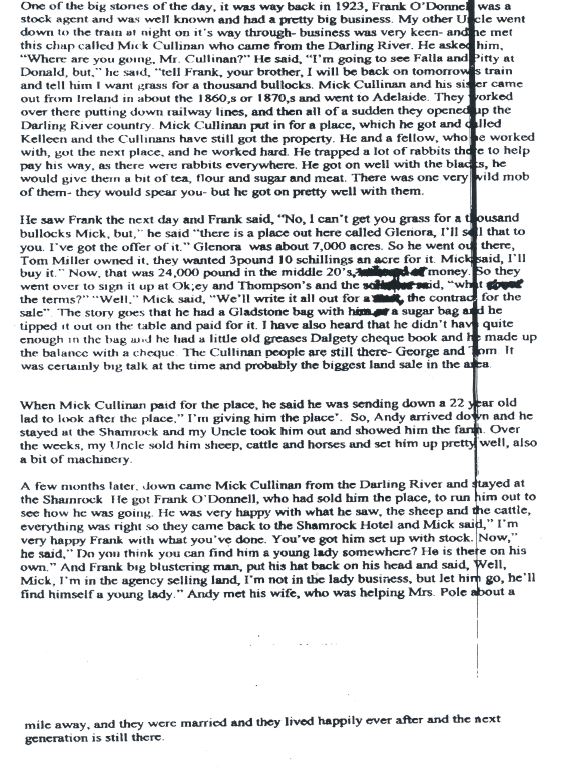
    Michael Cullinan (father to my paternal grandmother, Kelleen Cullinan-Curran) bought part of Marlbed North, a 7000 acre station for his 20 year old son, Andy (Andrew Edward Cullinan:1896-1984) in 1920. 

    One version of the purchase of the land is told below by Sue (unsure of surname) in a letter to Rhonda (unsure of surname) in 2001.

    Story retold from Charolais Agriculture Magazine
    by Sue (niece of Tom) & Col in a letter to Rhonda in 2001.

    Gwen Stannard (Curran, D., 1990, The Family History of James Cullinan) tells another version of the land purchase, writing that Andy and his dad, Michael travelled to Marlbed North near Birchip and paid 3-7-6 (pound, schilling and pence) an acre for it. She says that they named it Glenora.

  • Cuff

    Mary Ann Haywood Cuff was the third wife of my paternal great grandfather, Michael Cullinan (father of Kelleen Cullinan-Curran). They married in 1914 in Wentworth, New South Wales and remained married till Michael’s death in 1924.

  • Burungie Station

    Burungie Station was north of Broken Hill, New South Wales.

    Michael Cullinan and Mary Ann Haywood Cuff

    In 1921, Michael Cullinan purchased a western lands lease in the triangle formed by Menindee, Broken Hill and Wilcannia for 6 pence per acre. The name of the lease was Burungie Station, NSW, Australia.

    Information sources:

    • Private notes by Doug Curran.
    • Gordon Curran in The Family History of James Cullinan (1990). 

    Michael made Jack Plant the station manager. He then lived with Jack Plant and Jack’s daughter, Doll in Broken Hill. No mention is made of his wife, Mary Ann Cuff.

    Source: Gordon Curran, The Family History of James Cullinan, 1990

    In 1924, Michael Cullinan died at 72 years of age. His wife (Mary Ann Haywood-Cuff) and brother were left an annuity of 1 pound per week, his three daughters, 500 pounds. The surplus of the estate was left to his grandchildren.

    Michael Cullinan will details

    Source: Sunday Times, NSW, 29-03-1925

  • Michael and Betsy Cullinan-Kelleen Station

    1888: Michael Cullinan (36 years old) and Betsy Wakefield (27 years old) moved to Kelleen Station (Pooncarie, NSW), one year after their marriage in Kapunda, South Australia.

    Together with their first child, Michael, they arrived on a two horse driven cart. Michael had 1000 pounds to his name courtesy of his rabbiting period with Tom Wakefield who was Betsy’s brother.

    Betsy Wakefield and Michael Cullinan
    Betsy and Michael Cullinan with family

    Initially Michael and Betsy lived on the bank of the Darling River, in an area known as the Old Woodshed Billabong. 

    …a flood [in 1890] drove them out and they lived in tents on the bank of the deep creek near where the bridge over the creek is today. They lived there till the floods went down, then [Michael] built a 2 roomed house out of pine logs and a bark roof, where Kelleen is today…

    … It had a iron roof just over the bark which made it cooler in summer.

    There was 6 blocks shown on Para station at one time, 10 000 acres [each] and he got one. There was no improvements or fences so he had to put up a boundary fence. 

    Kelleen was 6 miles by 3 miles wide. He and his brother Jack put in 3000 acres cropping.”

    (Phyllis Plant, letter)

    According to Gordon Curran (Curran, D, The Family History of James Cullinan 1816-1990), Michael called his property Killeen named after his birth place but it was registered as Kelleen.

    Gordon Curran describes their two roomed house as having:

    pine slab walls and bark room with gum saplings for purlins, fastened with wire from an old fence. This was later extended and covered with an iron roof. The floor was probably dirt to start with but later was of pit sawn gum.

    Gordon Curran

    They have sheep but the wool clip doesn’t pay enough. Michael and other homesteaders try to sell back their leases for 50 pounds each but they are rejected. He then plants 600 acres of grain crops using river boats for transport. Chaff was transported by camel trains to Cuthero and Moorara. 

    Michael installs a production line system in his chaff shed with a double bagger chaff cutter and grain mill, driven by a Marshall steam engine, which is later used to drive the shearing machines

    Source: Gordon Curran in Curran, D, The Family History of James Cullinan 1816-1990.

    Marshall Steam Engine
    A Marshall Steam Engine. Source: https://collection.maas.museum/object/46878

    Michael and Betsy had seven children at Kelleen Station, Michael 1887, Florence 1889, Mary-Ann 1891, James 1893, Andrew 1896, Kelleen (my paternal grandmother) 1899, and Catherine 1901.

    1900: Tom Wakefield (Betsy’s brother) comes to work for Michael as a station hand. He is granted a small piece of land called Corifin. It has no water available so Tom and his family live in a four room cottage at Kelleen. He works for Michael for four years (Source: Wakefield Family History).

    On June 2, 1904 Betsy died. She was 43 years old. The previous year her seventh child, Catherine had drowned in the Darling River at Kelleen Station. She was 2 years old.

    1905: Tom Wakefield sells Corifin to Michael Cullinan. 

    For further Information, see the Kelleen Station page.